Which AI Is the World Actually Googling? 13 Tools by Monthly Search Demand
People argue endlessly about which AI is "winning," usually from vibes or a leaderboard of opinions. So we went to the one place that records what billions of people actually want: Google. We pulled 12 months of worldwide Google search volume (June 2025 to May 2026) for 13 AI products using Google's Keyword Planner, and the gap between perception and demand is bigger than most takes admit.
TL;DR
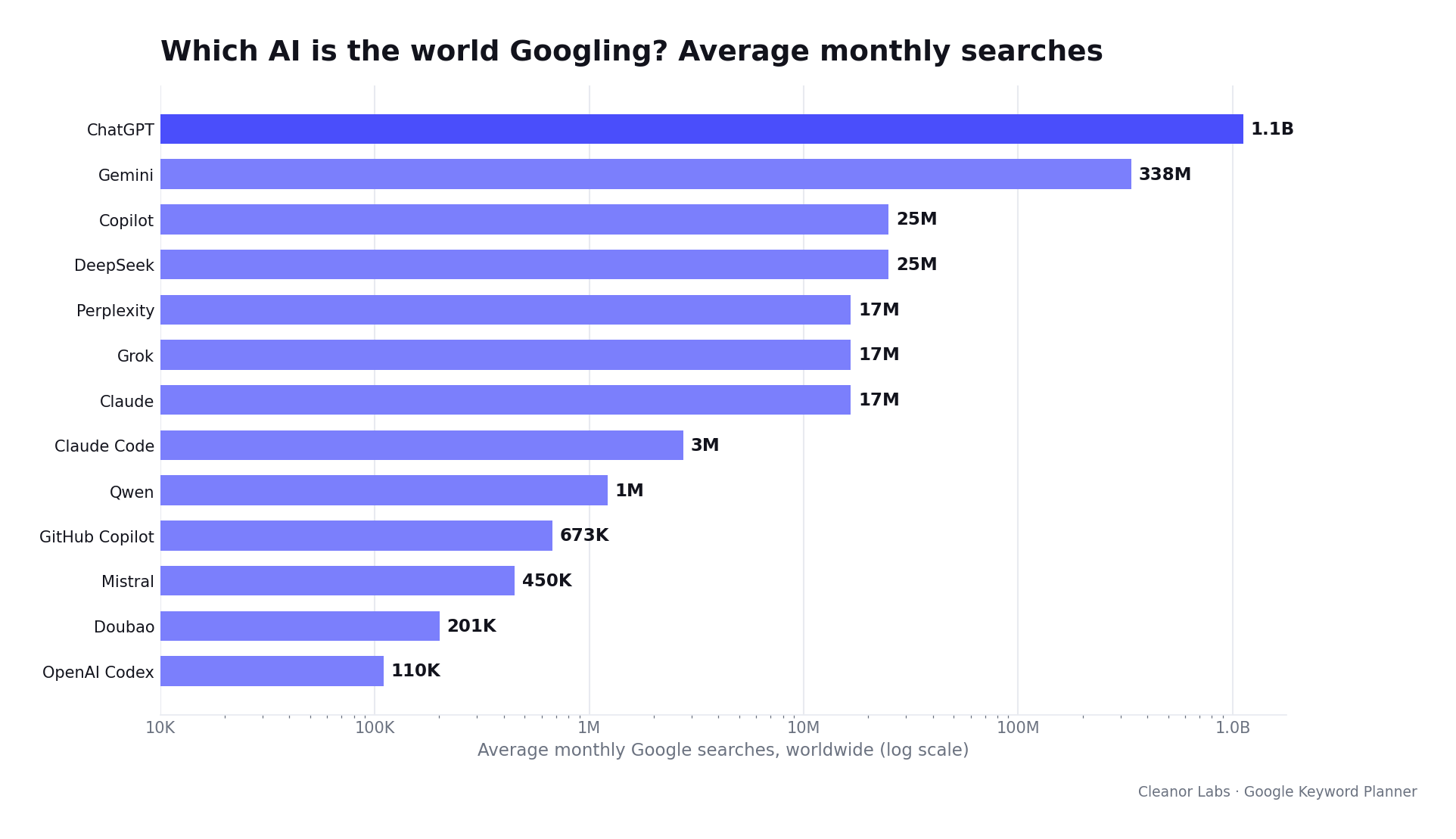
- ChatGPT is not just first, it is the category: about 1.12 billion searches a month, roughly 72% of all search demand across the 13 tools combined.
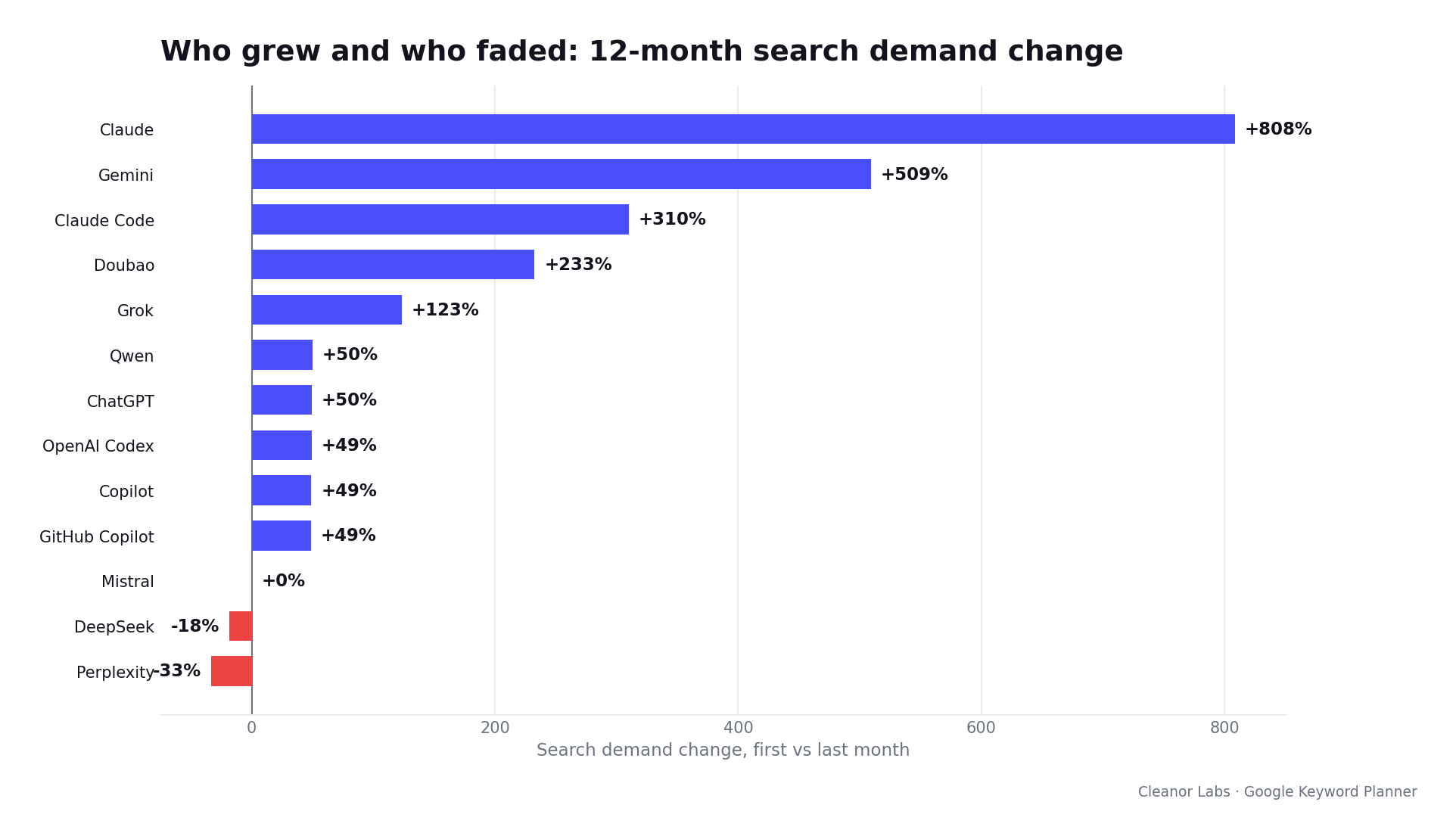
- Gemini is the runaway grower of the year, up about 509% (83M to a 506M peak), helped by Google wiring it into Search, Android, and Workspace.
- Claude is the fastest riser of all in percentage terms, up about 808% (6.1M to 55.6M) and still climbing into May 2026.
- DeepSeek peaked first, then faded: its viral January moment shows as a mid-2025 high that settled about 18% lower by spring.
- Perplexity is the notable decliner, down about 33% from its autumn peak, while Grok swung up then cooled after January.
How big is the gap between ChatGPT and everyone else?
ChatGPT does not lead the AI search race so much as contain it. At about 1.12 billion average monthly worldwide searches, it pulls roughly 72% of the combined demand across all 13 products we measured, and it is still growing, peaking at about 1.38 billion in May 2026. Gemini, in clear second, averages about 338 million. Every other tool in the study, including names that dominate tech headlines, lives an order of magnitude below that.
Put differently: the third through thirteenth tools combined do not come close to Gemini alone, and Gemini alone is less than a third of ChatGPT. For a category that feels like a crowded, fast-moving fight, search demand says it is mostly a one-name market with a strong second and a long tail.
| Rank | AI tool | Avg searches/mo (worldwide) | 12-month change | Pattern |
|---|---|---|---|---|
| 1 | ChatGPT | 1,120,000,000 | +50% | Dominant, still growing |
| 2 | Gemini | 338,000,000 | +509% | Explosive growth |
| 3 | DeepSeek | 24,900,000 | -18% | Spiked early, faded |
| 4 | Copilot | 24,900,000 | +49% | Steady climb |
| 5 | Claude AI | 16,600,000 | +808% | Fastest riser, still up |
| 6 | Grok | 16,600,000 | +123% | Up then cooled |
| 7 | Perplexity | 16,600,000 | -33% | Declining |
| 8 | Claude Code | 2,740,000 | +310% | Developer surge |
| 9 | Qwen | 1,220,000 | +50% | Slow build |
| 10 | GitHub Copilot | 673,000 | +49% | Steady |
| 11 | Mistral AI | 450,000 | 0% | Flat |
| 12 | Doubao | 201,000 | +233% | Rising from a small base |
| 13 | OpenAI Codex | 110,000 | +49% | Niche, developer-only |
Combined, the 13 tools draw about 1.56 billion searches a month.
Who actually grew, and who is fading?
Average volume hides the story. The interesting signal is the shape of each tool's 12-month curve.
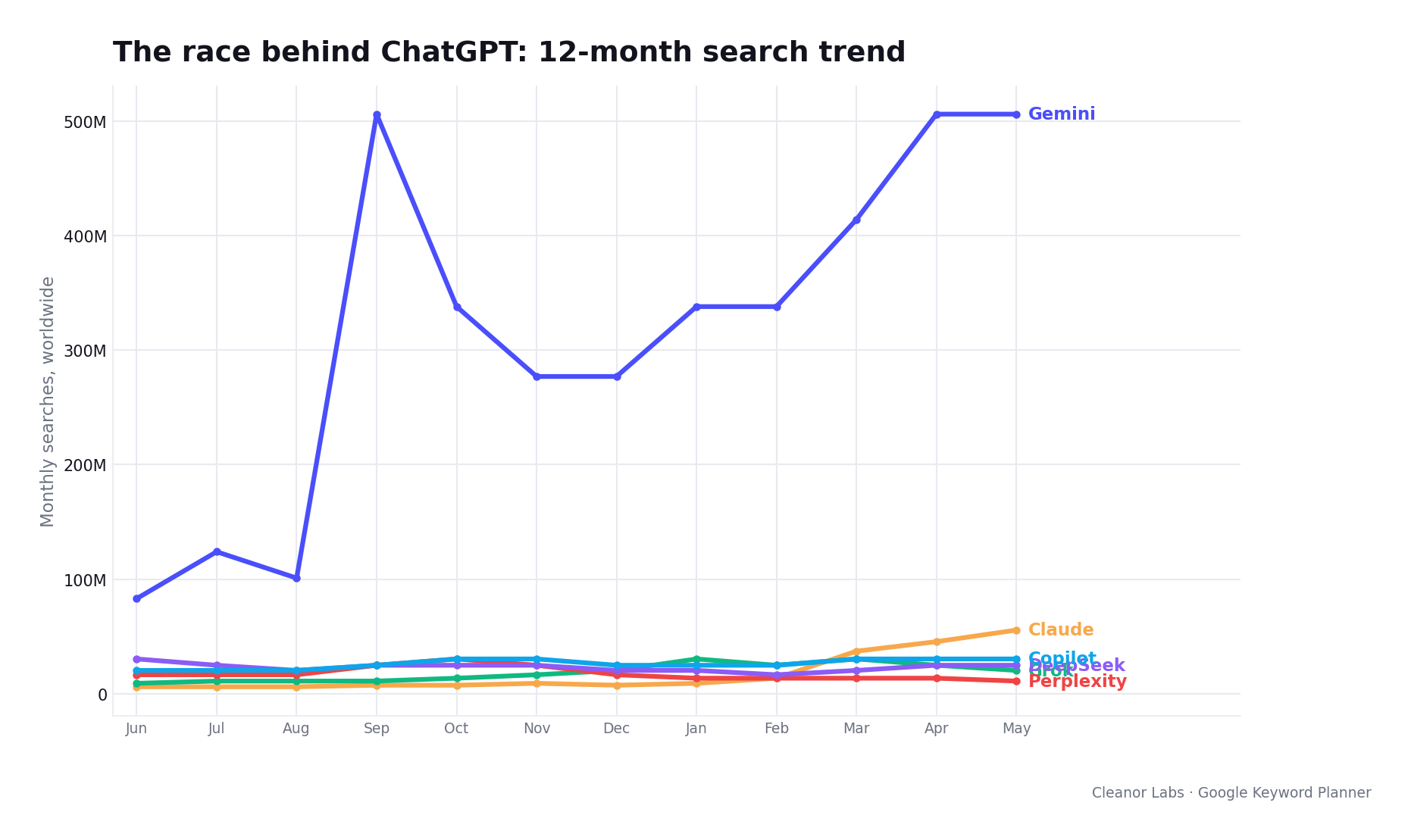
- Gemini, +509%. The clearest growth story by absolute scale. It went from about 83 million searches in June 2025 to a 506 million peak by autumn and held high. This is what happens when a model stops being a separate app and becomes a default surface inside Search, Android, and Workspace.
- Claude, +808%. The steepest percentage climb in the set, from about 6.1 million to 55.6 million, and unlike most tools its peak is the most recent month, not a past spike. Demand was still accelerating at the end of the window.
- Claude Code, +310%. A developer-tool breakout, from about 1.2 million to a 6.1 million peak, evidence that "AI in the terminal" went mainstream among engineers over the year.
- DeepSeek, -18%. A useful counterexample to hype. Its big moment was early: the highest month in our window is the first one (about 30.4 million in June 2025), and it settled lower through spring. Viral launches can front-load demand that does not hold.
- Perplexity, -33%. The clearest decliner, peaking around 30.4 million in autumn 2025 and drifting down to about 11.1 million. Answer-engine curiosity cooled as the big assistants added their own search.
- Grok, +123% but cooling. It swung up to a roughly 30.4 million peak in January 2026, then eased back, a spikier curve tied to news cycles rather than steady adoption.
Is the most-searched AI the one people think will survive?
Search demand measures attention, not faith. To contrast the two, we lined our data up against the community "survival" leaderboard at KilledByGPT.com, where 10,121 votes rank AI products by "Death %," the share of voters who think a product is likely to be replaced. The two rankings disagree in revealing ways.
- The most-searched tool is not the most-trusted-to-survive. ChatGPT leads search by a mile but sits mid-pack on perceived survival (about 26% "death").
- The tool voters rate safest, Claude (about 18%, the lowest in that leaderboard), draws only about 16.6 million searches, a fraction of ChatGPT, even as its search curve grows fastest.
- The tools voters see as most at risk, like Mistral Le Chat and Doubao, are also near the bottom of search demand, so on those the crowd and the search data agree.
The takeaway: attention and confidence are different axes. People Google ChatGPT out of habit and ubiquity, while a smaller, more technical audience is betting on Claude. Both signals are real, and a product strategy that reads only one of them will misjudge the market.
What this means for anyone building on top of AI
For app makers, marketers, and tool builders, the practical reading is simple. Distribution beats novelty: Gemini's surge came from being embedded where people already are, not from a standalone pitch. Habit compounds: ChatGPT's lead widened even in a year of strong competitors. And hype is not demand: DeepSeek and Grok show that a viral peak can fade, while Claude shows that quieter, steadier growth can outrun it over 12 months.
At Cleanor Labs we build AI-assisted tools ourselves, including on-device photo cleanup and the Another You AI photo editor, so we track this demand curve closely. The same lesson that shows up in our storage research shows up here: what people actually do at scale, measured rather than guessed, is a better guide than the loudest opinion.
Methodology
We queried Google Ads Keyword Planner for worldwide (all locations, English) historical search metrics on 13 brand keywords, one representative query per product: chatgpt, gemini, claude ai, grok, perplexity, deepseek, copilot, qwen, mistral ai, doubao, github copilot, openai codex, and claude code. Figures are average monthly searches and the month-by-month series for June 2025 through May 2026, as reported by Google. Percentages are first-month to last-month change within that window. Volumes are Google's bucketed estimates, not exact counts, and reflect Google Search demand only, not usage inside each product or traffic from other engines.
Limitations. Brand names are imperfect search proxies. "Gemini" also captures the zodiac sign and other unrelated meanings, "grok" and "claude" are common words and names, and "copilot" spans Microsoft Copilot and the general term, so those totals likely overstate pure product intent. We used a single representative keyword per tool rather than every alias, so absolute volumes are conservative for tools with many query variants. The KilledByGPT comparison is opinion-poll data (10,121 votes) and is cited only as a perception contrast, not a measurement of quality.
References
- Google Ads Keyword Planner, worldwide historical search metrics, June 2025 to May 2026.
- KilledByGPT.com leaderboard, "AI Products Ranked by Vulnerability (Death %)," based on 10,121 votes (accessed 2026).